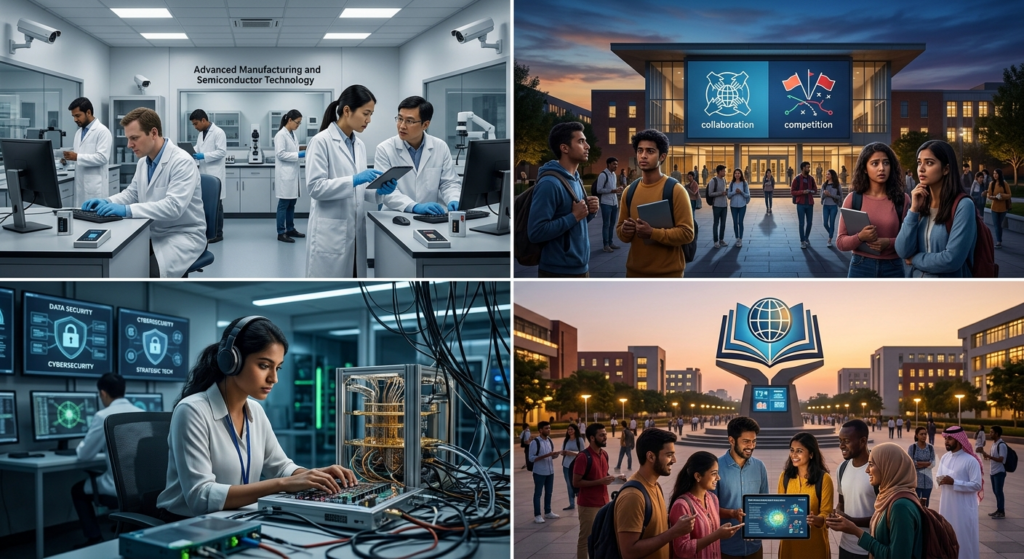
In the past, universities were often viewed as neutral spaces where knowledge flowed freely across borders. Researchers collaborated regardless of nationality. Students travelled internationally in pursuit of academic excellence. Scientific discoveries were celebrated as global achievements.
Today, that world is changing. Education has become a strategic asset in the contest for economic power, technological leadership, and national security. The growing rivalry between major powers, particularly the United States and China, is reshaping the global higher education landscape. Universities, research laboratories, and technology companies are increasingly finding themselves at the centre of geopolitical competition.
The geopolitics of knowledge is no longer a distant concept discussed only in diplomatic circles. It is influencing what universities can research, who they can collaborate with, and where students choose to study.
When Knowledge Becomes Power
For centuries, nations competed for territory, resources, and military strength. In the twenty first century, knowledge has emerged as perhaps the most valuable resource of all.
Artificial intelligence, semiconductor technology, biotechnology, quantum computing, and advanced manufacturing are expected to define future economic and military power. Countries that lead in these fields are likely to shape the global order for decades.
Universities play a critical role in this competition. They are not only centres of learning but also engines of innovation. The research conducted on university campuses often forms the foundation of technologies that transform industries and influence national security. As a result, governments are paying closer attention to academic research than ever before.
The US China Academic Divide
The most visible example of this shift is the growing competition between the United States and China. For many years, universities in both countries maintained strong academic relationships. Thousands of Chinese students enrolled in American universities, while researchers collaborated extensively on scientific projects.
However, concerns related to intellectual property, technology transfer, and national security have changed the equation. Restrictions on research partnerships have increased. Certain areas of collaboration are now subject to greater scrutiny. Sensitive technologies are increasingly viewed through a strategic lens rather than a purely academic one.
The result is a gradual fragmentation of what was once a highly interconnected global research ecosystem. Many universities are now balancing two priorities that sometimes conflict with one another. The desire for international collaboration and the need to comply with national security considerations.
Research Under New Restrictions
Academic research has traditionally thrived on openness. Scientists publish findings, share data, and build upon one another’s work. Yet in recent years, several countries have introduced stricter controls over research involving advanced technologies. Fields such as artificial intelligence, quantum computing, cybersecurity, and biotechnology have become areas of strategic concern.
Governments increasingly recognise that breakthroughs in these sectors can have both civilian and military applications. As a consequence, some research projects face additional approval processes, export controls, and partnership restrictions. While policymakers argue that such measures protect national interests, critics worry that excessive restrictions may slow scientific progress and limit innovation.
The debate highlights a difficult question. How can countries safeguard sensitive technologies while preserving the openness that drives discovery?
Technology Controls and the New Knowledge Economy
Technology controls have become one of the defining features of modern geopolitical competition. Access to advanced semiconductor technology, high performance computing systems, and critical digital infrastructure is now closely linked to national strategy. Governments are imposing restrictions on the transfer of certain technologies and expertise.
These developments are affecting universities as well. Research funding priorities are changing. International partnerships are being evaluated more carefully. Academic institutions are increasingly expected to align with broader national objectives.
For students, this means that fields such as artificial intelligence, data science, robotics, cybersecurity, and semiconductor engineering are becoming more strategically important than ever before.
Can Academic Collaboration Survive?
Despite growing tensions, global challenges continue to demand international cooperation. Climate change, public health, food security, sustainable energy, and environmental protection cannot be solved by any single nation acting alone. Scientific collaboration remains essential for addressing problems that transcend borders. Many universities are therefore seeking a middle path. They aim to protect sensitive research while maintaining international partnerships in areas that benefit humanity as a whole.
Joint research programmes, student exchanges, and multinational scientific initiatives continue to play a vital role in advancing knowledge. The challenge lies in ensuring that geopolitical tensions do not completely undermine academic cooperation.
What It Means for India
For India, the changing geopolitics of knowledge presents both challenges and opportunities. As the world’s largest youth population enters higher education, India has the potential to become an important global research and innovation hub. International universities, multinational companies, and research institutions are increasingly looking towards India as a partner.
India’s ability to maintain relationships with multiple global powers places it in a unique position. It can serve as a bridge between different knowledge ecosystems while strengthening its own research capabilities.
At the same time, India must invest significantly in universities, research infrastructure, faculty development, and innovation ecosystems if it wishes to compete in a rapidly evolving global landscape.
The Future of Knowledge
The age of unrestricted academic globalisation may be giving way to a more complex era. Knowledge is no longer viewed solely as a public good. It is increasingly regarded as a strategic resource. Yet education remains one of humanity’s most powerful tools for cooperation, progress, and understanding.
The future will likely be shaped by how effectively nations balance competition with collaboration. Universities will remain at the heart of this delicate equation. In an age defined by global rivalry, the battle for influence may not be fought only in boardrooms, laboratories, or diplomatic negotiations. It may also be fought in classrooms, research centres, and university campuses around the world.
Source: TMN