For generations, international education followed a familiar script. A student left home, boarded a flight, crossed continents, and spent years studying in a foreign country. The experience was as much about migration as it was about education.
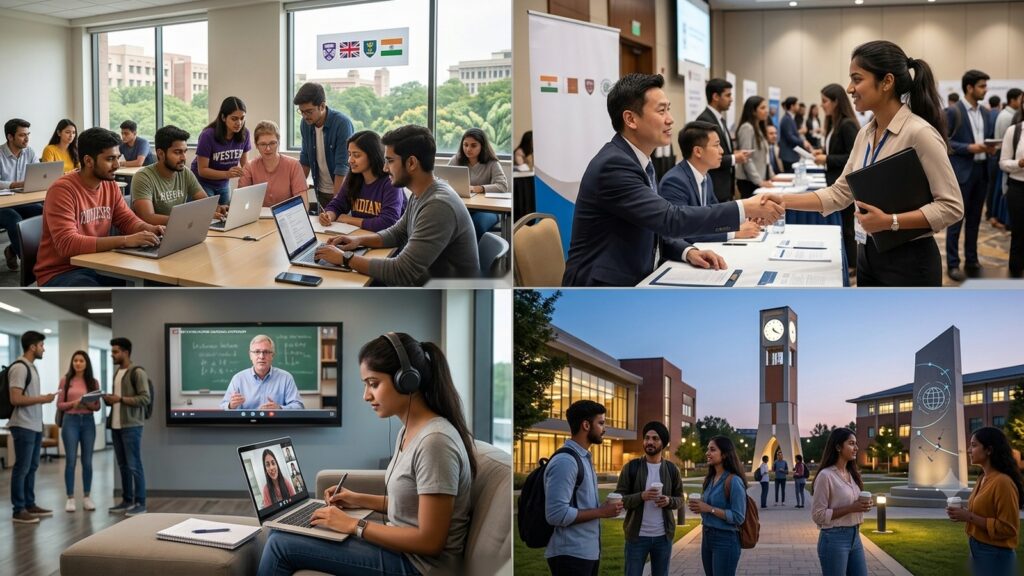
Today, that model is being challenged. A quiet revolution is reshaping global higher education. International universities are opening campuses in new countries. Dual degree programs are becoming increasingly common. Hybrid learning models are blending online and classroom experiences across borders. Prestigious foreign institutions are exploring opportunities in emerging education hubs, including India.
As these changes gather momentum, an intriguing question is beginning to emerge. Can international education happen without migration? The answer may define the future of global learning.
The End of Geography as a Barrier
Technology has transformed almost every aspect of modern life, and higher education is no exception. Students can now attend lectures delivered from another continent, collaborate with classmates from different countries, and access world-class academic resources without leaving their hometown.
What was once considered impossible is gradually becoming routine.
Universities are no longer confined to a single location. Instead, they are evolving into global networks that deliver education across multiple campuses, countries, and digital platforms.
For students, this means international exposure is becoming increasingly accessible without the financial and emotional costs traditionally associated with studying abroad.
The Rise of Branch Campuses
One of the most significant developments in global education is the growth of branch campuses. Leading universities are establishing physical campuses outside their home countries to reach new student populations. These institutions offer the same curriculum, academic standards, and often the same degree awarded by the parent university. Students gain access to an international education experience while remaining closer to home.
For families concerned about rising tuition fees, visa uncertainties, and living expenses overseas, branch campuses offer an attractive alternative. They combine global credentials with reduced costs and greater convenience. The model is already gaining momentum across Asia, the Middle East, and several emerging education markets.
Dual Degrees Are Expanding Opportunities
Another trend transforming international education is the growing popularity of dual degree programs. Under these arrangements, students study at two institutions, often located in different countries, and graduate with qualifications from both. In some cases, students spend part of their program in their home country and part abroad. This approach offers the best of both worlds.
Students gain international exposure, intercultural learning, and global academic recognition while reducing the overall cost of overseas education. Employers increasingly value graduates who possess both local understanding and international experience, making dual degrees particularly attractive in a competitive job market.
Hybrid Learning Is Redefining Mobility
The pandemic accelerated the adoption of online learning, but its long-term impact extends far beyond emergency remote teaching. Today, many universities are embracing hybrid models that combine digital learning with in-person experiences. Students may complete portions of their program online before travelling for specialized modules, internships, laboratory work, or capstone projects.
This flexibility is changing the economics of international education. Instead of spending several years abroad, students can access global academic expertise while limiting the duration and cost of overseas study. For many families, this represents a more practical pathway to international qualifications. The future of education may involve mobility, but not necessarily full-time relocation.
International Universities Are Looking at India
India’s higher education landscape is entering a transformative phase. Recent policy reforms have encouraged greater international collaboration and opened doors for foreign universities to establish a stronger presence in the country.
This development has the potential to reshape study abroad aspirations for millions of Indian students. Rather than travelling overseas, students may soon have access to globally recognized programs and international faculty within India itself. Several leading institutions are already exploring partnerships, collaborative programs, and physical campuses.
For a country with one of the world’s largest student populations, the implications are enormous. International education could become more affordable, more inclusive, and accessible to a far broader segment of society.
What Students Still Cannot Replicate
Despite these advancements, there are aspects of studying abroad that remain difficult to reproduce. Living in a foreign country exposes students to different cultures, languages, work environments, and social systems. It fosters independence, adaptability, and global perspectives that often emerge through everyday experiences outside the classroom.
Networking opportunities, internships, and post-study employment pathways also continue to be important motivations for international mobility. For many students, studying abroad remains as much a personal journey as an academic one.
A Borderless Future for Global Education
The future of international education is unlikely to be defined by a single model. Instead, it will be shaped by greater flexibility and choice. Some students will continue to pursue traditional overseas degrees. Others will choose branch campuses, dual degree programs, or hybrid learning pathways. Many may combine several of these options throughout their educational journey.
What is becoming increasingly clear is that global education is no longer tied exclusively to physical migration. The campus of the future may not belong to one city, one country, or even one continent. It may exist across multiple locations, connected by technology, partnerships, and shared academic standards.
Students may still cross oceans. But increasingly, international education is finding ways to cross those oceans first.In the coming decade, the most significant transformation in higher education may not be where students go. It may be how the world comes to them.
Source: TMN