Inside the Global Hunt for Talent
A silent competition is unfolding across the globe. It is not being fought with weapons, trade sanctions, or political alliances. Instead, it is a contest for something far more valuable in the twenty-first century.
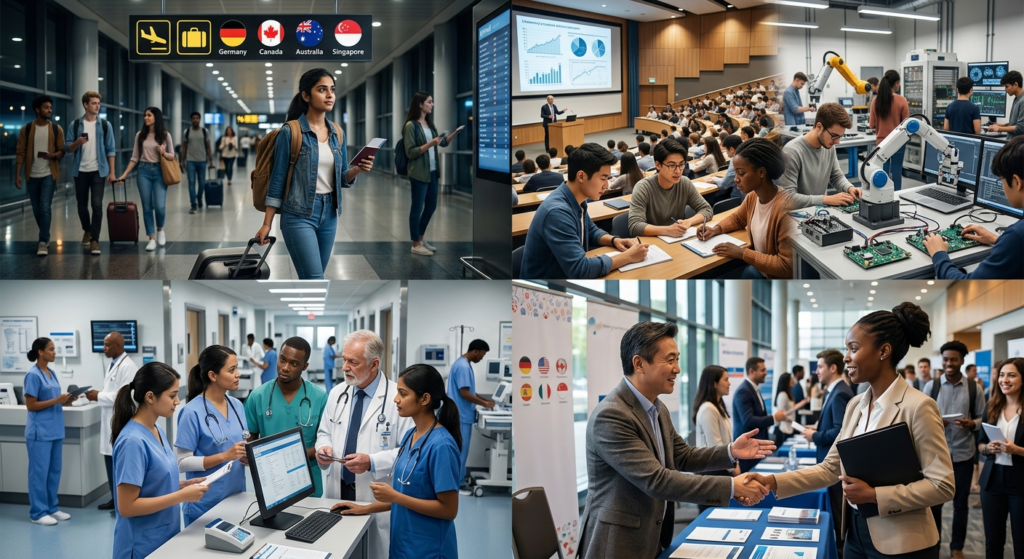
From Canada and Australia to Germany, the United Kingdom, New Zealand, Singapore, and the United States, governments are rewriting immigration policies, expanding post-study work rights, and creating faster pathways to permanent residency. The objective is becoming increasingly clear. These countries are not merely attracting international students. They are recruiting future workers, innovators, taxpayers, and citizens. The global war for talent has begun.
For students planning higher education abroad, this shift carries an important message. Study abroad is no longer just an educational decision. It has become part of a larger global strategy where nations compete to secure the skilled workforce needed for their future prosperity.
Why the Rules Are Changing
For decades, developed economies enjoyed steady population growth and abundant labour markets. Today, many of those assumptions no longer hold true. Several advanced economies are facing declining birth rates and rapidly ageing populations. In countries such as Germany, Japan, Italy, South Korea, and even parts of North America, the number of retirees is growing faster than the number of young people entering the workforce.
This demographic imbalance presents a serious economic challenge. Fewer workers mean reduced productivity, slower economic growth, increased pressure on healthcare systems, and rising pension costs. Governments understand that maintaining economic competitiveness requires a steady supply of skilled professionals. Domestic populations alone cannot meet that demand. The solution increasingly lies beyond national borders.
Labour Shortages Are Reshaping Immigration
The demand for talent is visible across almost every major industry. Healthcare systems need nurses, therapists, doctors, and aged care specialists. Technology companies require software engineers, cybersecurity experts, and artificial intelligence professionals. Manufacturing industries are searching for engineers and technicians. Educational institutions need qualified teachers and researchers.
Many countries now report persistent labour shortages despite strong economies and advanced infrastructure. As a result, immigration policies that were once restrictive are becoming more targeted and strategic. Governments are prioritizing skilled migration programs designed to attract individuals capable of filling critical workforce gaps.
In many cases, these policies are no longer temporary solutions. They are becoming central pillars of national economic planning.
International Students Have Become Strategic Assets
Perhaps the most significant change has occurred in the way countries view international students. Historically, international education was primarily seen as an export industry. Universities attracted foreign students who paid tuition fees and contributed to local economies.
Today, the equation has changed. Governments increasingly recognize that international students represent an ideal source of future talent. They are already educated within the local system, familiar with the culture, proficient in the language, and often eager to contribute to the economy after graduation.
This explains why many countries have introduced generous post-study work opportunities. Graduates are being encouraged to remain, gain professional experience, and eventually transition into long-term residents. The classroom has effectively become a talent pipeline.
The New Geography of Talent Migration
India has emerged as one of the most important contributors to this global talent movement. With one of the world’s largest youth populations and a growing number of highly educated graduates, India supplies skilled professionals across healthcare, engineering, information technology, finance, research, and management.
Indian students now represent one of the largest international student communities in many major study destinations. Employers actively seek their expertise, adaptability, and technical capabilities. At the same time, competition among destination countries is intensifying. Each nation is attempting to position itself as the preferred destination for global talent.
Some offer streamlined visa pathways. Others provide permanent residency options, employment incentives, or favourable immigration policies for graduates in high-demand sectors. The competition is no longer just about attracting students. It is about retaining them.
Education and Immigration Are Becoming Interconnected
One of the most striking developments is the growing overlap between education policy and immigration policy. Universities are increasingly aligned with national workforce strategies. Programs in healthcare, engineering, data science, renewable energy, cybersecurity, and advanced manufacturing often receive greater support because they address future labour market needs.
Students are also becoming more strategic. They are evaluating not only university rankings and tuition fees but also employment prospects, work rights, and long-term settlement opportunities.
The decision about where to study is increasingly influenced by where a student may eventually build a career.
The Future Belongs to Talent
The global economy is entering an era where human capital may become more valuable than natural resources. Countries can build infrastructure, invest in technology, and develop industries. Yet none of these ambitions can be realized without skilled people to drive them forward.
This reality explains why governments around the world are competing so aggressively for talented individuals. It also explains why international education has become far more than an academic pursuit. For today’s students, studying abroad is not simply about earning a degree. It is about positioning themselves within a global marketplace where skills, knowledge, and innovation are in extraordinary demand.
Source: TMN